Showing posts with label Vacuum Leaks. Show all posts

Monday, May 29, 2006

Virtual vacuum leaks

I have a really good quote about vacuum leaks, and thought that I had blown the chance to use it, already having fixed one leak. Today I tried to restart the Stern-Gerlach experiment, and found that it had a huge leak in it. There was a very good reason for this: I had attached a light to the vacuum system to check whether it was aligned properly. This light was built in to what looks like a leak-tight metal plate, but which actually has a huge hole in it.

The picture below shows what happened: the air which was pumped out by the pump was continuously replaced by the air coming in through the leak. Now the funny thing is that the leak could only be heard by listening to the bellows, which I drew as being the zig-zaggy thing. At this point you could hear a hissing sound. This hissing sound couldn't be heard at the point where the air came in, only when it passed through the bellows.
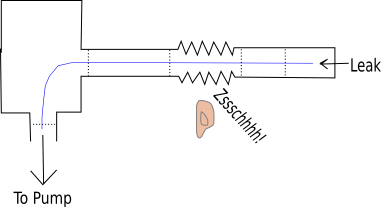


After a couple of hours, and after installing a spare bellows which made exactly the same noise, I worked out what was wrong, and removed the piece with the hole in. For a while I was annoyed, but then I realised that I may have created a new musical instrument: the leakophone. Presumably by varying the tension in the bellows you could create a whole range of hissing sounds with various tones. Add a couple more bellows and you could play a lovely tune. Before I forget, that quote, stolen from R.K. Fitch who claims that it was a student's answer to an exam question.

The essential components of a high vacuum system are a rotary pump, a diffusion pump, and a leak

Saturday, April 22, 2006

Leak Chasing

Yesterday I found that the Stern-Gerlach apparatus had a vacuum leak. Molecules in the atmosphere travel only about a tenth of a micrometer before they hit another molecule and go off in a different direction. If you want to get a molecule to fly in a straight line for a whole metre then you have to get rid of most of the other molecules (removing roughly 99.9999999% of them should do the trick).

To do this you need a container and a sucking device (the pump). The pump has the job of removing the molecules, and the container has the job of not letting new ones get in. If everything goes well you will have a vacuum container with practically nothing in it.

The trouble with vacuum containers is that they tend to leak. And they follow Murphy's laws of vacuum leaks.

1/ A vacuum leak will never be quite large enough that you can hear the air whistling through it, but will be large enough to screw up your measurement.
2/ A vacuum leak will always occur at the point in a vacuum system furthest away from a pressure gauge.
3/ A vacuum leak will always occur at point closest to the most sensitive device in your system.

Laws 2 and 3 combine to form the vacuum-system exclusion principle: It is impossible to mount a pressure gauge next to your most sensitive device, usually because you have the wrong connector.

Fortunately laws 2 and 3 can also be used to divine the exact position of your leak. If you want to be really sure you can buy yourself a nice Helium leak chasing device