If you don't know what cricket is it's about time to find out, for the cricket world cup is underway in the West Indies. India look as though they are about to go out and Pakistan have departed minus their coach, who departed in the dearly sense of the word.
Here is a brief guide to cricket:
1/ How to bat for Kazachstanis.
2/ The game's jargon explained by Willow and Stumpy.
3/ The tea towel explanation of the game, and also in German.
4/ An actually quite helpful explanation of the game.
5/ Of course all this knowledge is no use if you don't play with style. Curtley Ambrose demonstrates.
So having got through all that you have deserved a few beers, just keep the number of the coastguard to hand.
Sunday, March 25, 2007

Thursday, March 22, 2007
Lame Ducks Fail to Quack
The Bochumer Cliche reports...
Torpedo Entenhausen looked like ducks out of water in their 12 (Twelve, 0b1100, 0o14) - 3 defeat. The defence had been hoping to be as mean as Scrooge McDuck, but instead it was open day at the money bin as the opposition went into an early lead. Fowl play saw both sides reduced to 10 players, and despite endofphil breaking his season's duck by feathering the ball into an empty net, the goose had thoroughly been cooked. The Entenhausen keeper twaddled off with 10 minutes remaining, and the performance has to be put down as "phooey, phooey and phooey".
Torpedo Entenhausen looked like ducks out of water in their 12 (Twelve, 0b1100, 0o14) - 3 defeat. The defence had been hoping to be as mean as Scrooge McDuck, but instead it was open day at the money bin as the opposition went into an early lead. Fowl play saw both sides reduced to 10 players, and despite endofphil breaking his season's duck by feathering the ball into an empty net, the goose had thoroughly been cooked. The Entenhausen keeper twaddled off with 10 minutes remaining, and the performance has to be put down as "phooey, phooey and phooey".
Tuesday, March 13, 2007
The Fartela
Following on from the great interest in my discussion of the mole, I thought I'd move on to the Candela, a unit of light intensity. This is one of the seven base units of the SI system, and most people would assume that it is important.
Why, in this case, despite studying physics for longer than is healthy, have I never used the unit Candela? Or seen anyone who used the unit? Or derived anything from this unit? Or ever bought a 10 Candela lightbulb?

The Candela describes how bright a light source is. Whichever way you look at light, the important thing is that it transmits energy, and the energy in a certain time is a power, measured in Watts: Hence the 60 Watt lightbulb. A Watt is already defined in terms of metres, kilograms and seconds, so it would appear that light intensity doesn't need its own base unit. A pre EU-directive shopper may wish to disagree, though.
Imagine that you bought a 60 Watt light bulb, and found out that it didn't light up despite drawing the full 60 Watt. It might give you a warm feeling, or a sunburn, but if the wavelength isn't between 400 and 700 nanometres you won't see anything. This is why the Candela is needed: it combines the power emitted with the sensitivity of the human eye to find the perceived brightness of something.
[Mid post rant: German Gangsta Rap fucking sucks. Think 2 minutes of the same rhyme repeated with the odd different ending word, interrupted by gunshots. Kezboards fucking suck too, whz the fuck does windows think that opening a new tab makes zou want to tzpe differently. Smokers and internet cafes suck too.]
This seems fair enough, and most useful to know when buying a lightbulb, or looking for a new star to orbit your planet around. But why make it a base unit? The Candela is strictly only of any meaning to a human with working eyes. In the kingdom of the blind, how many Candelas does a lightbulb emit?
Seeing as the Candela describes the human perception (brightness) of an physical property (flow of energy), why not do the same for the other senses, and give them each an SI base unit. Sound is a wave, which transmits power, but humans only hear certain wavelengths (most people would say frequencies, but I'm trying to be consistent). Multiply the sound wave power by a human ear function, and you have a new unit: the Bella. Sounds for which the ear is sensitive would earn more Bellas than those at the limit of human hearing.
Smells are concentrations of certain molecules in the air, best measured physically as moles/cubic metre (although it may depend on the speed of those molecules, too, for all I know. Physicists don't worry much about smells, or personal hygiene). Multiply this concentration by a wuffiness factor which describes the sensitivity of the human nose and you have a new unit: the Fartela.
So why is the Candela a base unit? I think it is something to do with unification. This website lists lots of old units of perceived brightness: The Hefner Candle, the Violle, the Apostilb, the Blondel, the Footlambert, the Nit, the Skot and the Stilb. The world's photometric experts were probably so besides themselves with happiness when the Candela came into standard use that they made it a base unit.
Writing this, I've grown to like the Candela. It's useful, practical, and although it probably shouldn't be a base unit it surely deserves recognition in the google calculator.
Monday, March 12, 2007
The windscreen wiper.

I have learnt a most useful german gesture: Der Scheibenwischer ("The windscreen wiper"). The meaning is described here in german, and a quick translation is
Move your hand to and fro in front of your face. It looks like the windscreen wipers on a car. This gesture means "You must be crazy!".
I'm writing about this because Sascha Dum, a footballer with Alemannia Aachen, received a red card (video here, 3:40 in). Most neutral observers seem to think that only half a wiper cycle in the direction of the referee warrants only a yellow card, and that a red card should be reserved for a full double-cycled (left-right-left-right) wiper movement.
I wonder what happens if a player does this in an international competetion. What would a south american referee make of it all?
Sunday, March 11, 2007
She's the 1.66053886(28) × 10-24 moles
Here's a useful google calculator calculation: How many moles is a baker's dozen?. The google calculator will return any dimensionless unit in moles if you ask nicely, such as lightyear/foot (both distances), or kilogram/electron mass (both masses). The former means that a mole of footsteps will transport you millions of lightyears, the latter that a mole of electrons will weigh much less than a bag of sugar.
Google calculator thinks that a mole is just a large number. This is how I would think of it, too. The official definition of a mole is, however, as follows.
An amount of substance is "defined to be proportional to the number of specified elementary entities in a sample".
This is of course a load of bollocks (number yet unspecified, but hopefully less than a mole). The phrase "atoms, molecules, ions, electrons, other particles" is ridiculous. Do other particles include cows, donuts, shoes, ships and tins of sealing wax? If not, why not? If so, why not add a couple to the list:
And don't go all "complex objects" and "elementary particles": an atom isn't elementary in the slightest, and despite the name can be cut open at will.
Why do the SI want to make this distinction between "elementary entities" and everyday objects? Why not use moles to count things? The problem is that the mole is defined in terms of kilograms, and the definition of a kilogram is "equal to the mass of the international prototype of the kilogram." The fact that all known masses are dependent on a lump of metal in Paris staying intact has annoyed scientists for a while. One cow is presently 1.66053886 x 10⁻²⁴ moles of cows, but if the prototype kilogram loses mass—and in the last century it did—it could in the future be less.
Another problem is that nobody knows quite how many units are in a mole. This is why there is a (28) in the brackets of the title. This means that you could add (or subtract) 28 to (or from) the last two digits (86) and still be within the margin of error. So a cow could as much as 1.66053904 x 10⁻²⁴ moles of cows, or as little as 1.6605358 x 10⁻²⁴ moles of cows.
So presuming google calculator and I are correct in treating the mole as a counting unit (and who would wish to doubt this), all scientists don't know how many things they have, and are continously losing/gaining them too, depending on a lump of metal in Paris.
One way out of this crisis would be to count in units (the one), and define the kilogram in terms of electron masses. Thus scientists could again count with with the rest of the population. I don't think the chemists would like it, though.
As a reward for sticking with this post, here is The Answer in moles.
[Disclaimer: The Answer in moles contains error bars and may increase or decrease with time. The author accepts no responsibility for future changes to The answer in moles.]
Google calculator thinks that a mole is just a large number. This is how I would think of it, too. The official definition of a mole is, however, as follows.
1. The mole is the amount of substance of a system which contains as many elementary entities as there are atoms in 0.012 kilogram of carbon 12; its symbol is "mol."
2. When the mole is used, the elementary entities must be specified and may be atoms, molecules, ions, electrons, other particles, or specified groups of such particles.
An amount of substance is "defined to be proportional to the number of specified elementary entities in a sample".
This is of course a load of bollocks (number yet unspecified, but hopefully less than a mole). The phrase "atoms, molecules, ions, electrons, other particles" is ridiculous. Do other particles include cows, donuts, shoes, ships and tins of sealing wax? If not, why not? If so, why not add a couple to the list:
...the elementary entities must be specified and may be atoms, molecules, cows, ions, dildos or other particles.
And don't go all "complex objects" and "elementary particles": an atom isn't elementary in the slightest, and despite the name can be cut open at will.
Why do the SI want to make this distinction between "elementary entities" and everyday objects? Why not use moles to count things? The problem is that the mole is defined in terms of kilograms, and the definition of a kilogram is "equal to the mass of the international prototype of the kilogram." The fact that all known masses are dependent on a lump of metal in Paris staying intact has annoyed scientists for a while. One cow is presently 1.66053886 x 10⁻²⁴ moles of cows, but if the prototype kilogram loses mass—and in the last century it did—it could in the future be less.
Another problem is that nobody knows quite how many units are in a mole. This is why there is a (28) in the brackets of the title. This means that you could add (or subtract) 28 to (or from) the last two digits (86) and still be within the margin of error. So a cow could as much as 1.66053904 x 10⁻²⁴ moles of cows, or as little as 1.6605358 x 10⁻²⁴ moles of cows.
So presuming google calculator and I are correct in treating the mole as a counting unit (and who would wish to doubt this), all scientists don't know how many things they have, and are continously losing/gaining them too, depending on a lump of metal in Paris.
One way out of this crisis would be to count in units (the one), and define the kilogram in terms of electron masses. Thus scientists could again count with with the rest of the population. I don't think the chemists would like it, though.
As a reward for sticking with this post, here is The Answer in moles.
[Disclaimer: The Answer in moles contains error bars and may increase or decrease with time. The author accepts no responsibility for future changes to The answer in moles.]
Thursday, March 08, 2007
Some Other Team 3 - Torpedo Entenhausen 1
I joined a football team in the "Spare time league" and made my debut for Torpedo Entenhausen this week. I ran around a lot and caused a bit of trouble for the opposition, who weren't so keen on running but felt that at least one of them ought to run after me. This means that I can play again next week.
I have acquired the ironic nickname the "Kopfballungeheuer", which translates as "The heading monster". Despite being the tallest person on the pitch, I kept missing the ball, and on the occasions when I made contact the ball bounced off my head in a random direction.
Some links:
Elf defence for 'lingerie thief'
Comedy stretcher bearers
I have finally fallen for the google calculator. Calculations with units included are definitely the way forward and cut out many of my mistakes.
Thursday, March 01, 2007
Intelligence and dental assistents
I impressed three young female dental assistents this morning by telling them where they were, leading them up two flights of stairs and sending them down a corridor. After passing halfway down the corridor they remarked that I seemed to be most intelligent. I think it was the map-reading ability that did it.
Tuesday, February 27, 2007
The awful (use of the beautiful) german language.
In an attempt to regain some of my interest in physics I borrowed a book from the university library: "Ideengeschichte der Physik" by Wilfried Kuhn. The title means "a history of ideas in physics". It is a most frustrating book, for once I get past the language barrier it is most interesting. Sadly, I rarely manage this.
I like to think that I can read german, but when I see these sentences (the translation and bold highlighting is from me) I give up.
or
My only consolation myself is the knowledge that I Mark Twain had similar difficulties. Twain claimed that some newspapers went to print without ever reaching the verb at the end of the sentence, and used this example to make his point:
Twain then rants away,
May I suggest that it is equally absurd to say that something yet to be revealed is being held from the ceiling by horse's hair, or to include an entire lifespan of 69 years between an auxiliary and a past participle. I really want to understand, but it is way beyond me.
For completeness, here are the original german sentences.
und
I like to think that I can read german, but when I see these sentences (the translation and bold highlighting is from me) I give up.
Stephan Gray amazed his audience with "Homo electrificatus", A with threads of horse's hair on the ceiling secured free-swinging electrically charged lad
or
The discovery of Ewald Juergen von Kleist had been by the Physicist from Leiden, Petrus van Muschenbroek (1692-1761), author of the standard experimental physics textbook of his time, published.
My only consolation myself is the knowledge that I Mark Twain had similar difficulties. Twain claimed that some newspapers went to print without ever reaching the verb at the end of the sentence, and used this example to make his point:
But when he, upon the street, the (in-satin-and-silk-covered-now-very-unconstrained-after-the-newest-fashioned-dressed) government counselor's wife met
Twain then rants away,
A writer's ideas must be a good deal confused, a good deal out of line and sequence, when he starts out to say that a man met a counselor's wife in the street, and then right in the midst of this so simple undertaking halts these approaching people and makes them stand still until he jots down an inventory of the woman's dress. That is manifestly absurd
May I suggest that it is equally absurd to say that something yet to be revealed is being held from the ceiling by horse's hair, or to include an entire lifespan of 69 years between an auxiliary and a past participle. I really want to understand, but it is way beyond me.
For completeness, here are the original german sentences.
Der Englaender Stephen Gray (1666-1736) verblueffte sein Publikum mit dem "Homo electrificatus", einem mit Schnueren aus Rosshaar an der Decke befestigten frei schwebenden elektrisch aufgeladenen Knaben.
und
Die Entdeckung des Ewald Juergen von Kleist hatte der Leidener Physiker Petrus van Muschelbroek (1692-1761), Verfasser eines Standardlehrbuches der Experimentalphysik seiner Zeit, veroeffentlicht.
Saturday, February 24, 2007
Practical problems arouse.
I continued learning English this week. I know now the difference between like and such as (explained here), and between using and utilising (explained here).
Now try to analyse these sentences:
1/ Your best friend says to you
"I wish to have a girlfriend like yours."
"I wish to have a girlfriend such as yours."
The first would be a fine compliment, the second a threat.
2/ I may say
"I used my keyboard to type this sentence."
"I utilised my keyboard to beat to death the guy next to me, who is still listening to Roxette very loudly."
I now read things with a keener eye, and spotted a lovely mistake in a book about ultrasound that I'm reading:
The author of the book is Norwegian and knows a lot about ultrasound, so I firmly place any blame at the hands of his publishers and their proofreader. Every time I read this sentence, I find another mistake, but the really good one is arouse instead of arose. Getting turned on by severe practical problems must be quite distracting for most scientists.
Now try to analyse these sentences:
1/ Your best friend says to you
"I wish to have a girlfriend like yours."
"I wish to have a girlfriend such as yours."
The first would be a fine compliment, the second a threat.
2/ I may say
"I used my keyboard to type this sentence."
"I utilised my keyboard to beat to death the guy next to me, who is still listening to Roxette very loudly."
I now read things with a keener eye, and spotted a lovely mistake in a book about ultrasound that I'm reading:
Ideas of three-dimensional (3D) imaging of organs by beam scanning in 3D directions, was first introduced in the 50'ies, but severe practical problems arouse...
The author of the book is Norwegian and knows a lot about ultrasound, so I firmly place any blame at the hands of his publishers and their proofreader. Every time I read this sentence, I find another mistake, but the really good one is arouse instead of arose. Getting turned on by severe practical problems must be quite distracting for most scientists.
Saturday, February 17, 2007
A Witty Short Fresh English Electronic Blog Post.
I found out this week that I have a lot to learn about writing in English. My new colleagues assume that because I grew up in England, I know the rules of English grammmar and am capable of correcting their papers. To prove how wrong they are (I went to a compriensif skool, tha nos) I took this test on hyphenation and got 70%.
70% in an exam isn't too bad, but leaves enough mistakes. If you extrapolate a 70% success rate to an article several pages long, and include mistakes with commas and capitalisation, then the corrected article almost certainly contain several mistakes.
I am waiting for the first colleague to come and beat me up whilst holding a letter from a Journal saying, "We accept your paper for publication, but maybe you could get a native English speaker to proof-read the article before we publish it."
Of great fun is the "Royal Order of Adjectives", which explains why you drive an old red Italian sports car, and not a Italian red old sports car.
Change of profile.
I should have done this a couple of weeks ago, but now I have a new blog description. For the record, the old one was as follows.
The diary of a physicist being paid by the german government to go on holiday for 6 weeks.
The diary of a physicist being paid by the german government to go on holiday for 6 weeks.
Wednesday, February 14, 2007
The perils of prefixes.
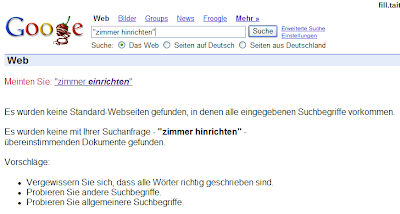
It is possible to change the meaning of many german verbs by using a prefix. "Zer-" is usually bad and leads to destruction.
stören : to disturb => zerstören : to destroy
"Ver-" is not quite so bad as "Zer-", but is rarely good.
schlafen : to sleep => verschlafen : to sleep for too long
"Er-" is worse than "Ver-", and debatably as bad as "Zer-", for it ends in certain death.
schiessen : to shoot => erschiessen : to shoot dead
I once got confused between being stung by a wasp: "Ich wurde von einer Wespe gestochen." and being stabbed to death by a wasp: "Ich wurde von einer Wespe erstochen."
Today I made another prefix mistake. I was trying to say "I furnished my room" and ended up claiming "I executed my room". One letter, one prefix, and a rather different meaning.
stören : to disturb => zerstören : to destroy
"Ver-" is not quite so bad as "Zer-", but is rarely good.
schlafen : to sleep => verschlafen : to sleep for too long
"Er-" is worse than "Ver-", and debatably as bad as "Zer-", for it ends in certain death.
schiessen : to shoot => erschiessen : to shoot dead
I once got confused between being stung by a wasp: "Ich wurde von einer Wespe gestochen." and being stabbed to death by a wasp: "Ich wurde von einer Wespe erstochen."
Today I made another prefix mistake. I was trying to say "I furnished my room" and ended up claiming "I executed my room". One letter, one prefix, and a rather different meaning.

Sunday, February 11, 2007
Things I've been meaning to write about...
... if I managed to get my computer situation sorted out are
1/ The Kunigunde lime tree in Kasberg
2/ "The physics of the Ether" by Paul Drude
3/ The renaissance of English one-day cricket and the Duckworth-Lewis method of deciding the winner of a rain-affected cricket match.
My problem is thus:
a/ I decided not to surf the internet for private stuff on my work computer.
b/ I decided that it is quite nice not to have a computer with internet in my flat. In the past week I read two-and-a-half books, ate quite well, and kept the flat clean. I fear that I wouldn't have done all of this had I been hooked up.
c/ I can't be bothered to type all of these things in internet cafes which seem to be full of people talking in turkish (Ali! Ali!), playing the "Greatest hits of Roxette as interpreted by the Chipmunks" on their iPod or doing lots of other annoying things.
I think the solution is to try and find a computer at the university which is not in my office but which I can use for blogging purposes (maybe in the library).
Vfl Bochum 0 - 1. FC Nuremberg 2
I thought there was something symbolic about this football match, seeing that I've left Erlangen (which is close to Nuremberg) to go to Bochum. Seeing as there was nothing else I really wanted to do on a rainy Sunday in Bochum I decided to go along.
The fist goal for Nuremberg came in the 88th minute, the second shortly after, but the Bochum fans standing next to me sort of knew what was coming, having seen an impressive display of comical finishing from their team in the second half. The players had the good grace to fall to the floor having lost the match and the fans seemed to accept that they had lost due to a lack of skill rather than lack of effort.
The fist goal for Nuremberg came in the 88th minute, the second shortly after, but the Bochum fans standing next to me sort of knew what was coming, having seen an impressive display of comical finishing from their team in the second half. The players had the good grace to fall to the floor having lost the match and the fans seemed to accept that they had lost due to a lack of skill rather than lack of effort.
Friday, February 02, 2007
Feierabend
I went to work today, and am now enjoying that relieved feeling at the end of a working day. Germans like to call this Feierabend (literally celebration evening).
My first work project is to help prepare an exam about electromagnetism. I've forgotten almost everything I knew about this subject, so I had to get a textbook from the library. I was most pleased to see my old friend "Electromagnetic Waves and Radiating Systems" by Edward Jordan and Keith Balmain. It is a delightful book, although a little dated. Luckily electromagnetic theory hasn't changed over the last 50 years, although labour relations, feminism and household appliances have come on a bit since the 50's, as demonstrated by the following quote from the book.
My first work project is to help prepare an exam about electromagnetism. I've forgotten almost everything I knew about this subject, so I had to get a textbook from the library. I was most pleased to see my old friend "Electromagnetic Waves and Radiating Systems" by Edward Jordan and Keith Balmain. It is a delightful book, although a little dated. Luckily electromagnetic theory hasn't changed over the last 50 years, although labour relations, feminism and household appliances have come on a bit since the 50's, as demonstrated by the following quote from the book.
A man can do work for a 12-hour day at the rate of about 40 Watts, which is less than the power required to run his wife's electric washing machine.
Saturday, January 27, 2007
Train Connections
I'm back in Erlangen from Bochum. On the way I tried to comfort a girl who failed to get off the train at Hanau because the doors didn't open. This meant that she had to take a round trip to Wuerzburg and back which took a couple of hours. I pointed out that it wasn't that bad, there was no need to cry and this kind of thing happens to me all the time.
And just to prove that I wasn't making this up I then got on a train in Nuremberg that went straight through Erlangen and out the other side. I didn't know that any trains did this (duh!), so I took an hour long trip to Bamberg and back.
And just to prove that I wasn't making this up I then got on a train in Nuremberg that went straight through Erlangen and out the other side. I didn't know that any trains did this (duh!), so I took an hour long trip to Bamberg and back.
Friday, January 26, 2007
The Model 3107 Chair

Today I got fed up with looking for flats, so I got on a tram and went to Strünkende Castle which is at the end of the line. It's several hundred years old and now houses a museum. The museum has lots of the usual stuff (armour, weapons, axes, pots, bones etc) and also a collection of 20th century chairs.
Possibly the most famous chair of the 20th century is now in the hands of the Victoria & Albert Museum. It belonged to the photographer Lewis Morley and was used in 1963 (the year that sexual intercourse began) for a photograph with Christine Keeler, who was then embroiled in the Profumo affair.
The museum in Strünkende Castle explained the appeal of this chair, which is a copy of the model 3107 chair by Arne Jakobsen. So if you ever run into this photo again, be sure to gaze at it with an open jaw and dribble "Phwoooar, that's a model 3107 chair".

Wednesday, January 24, 2007
Bogestra
I'm still in Bochum and still looking for somewhere to live. My favourite word in Bochum is "Bogestra". It stands for "Bochum-Gelsenkirchener Strassenbahnen" which is the company which runs the trams and buses in Bochum (and in neighbouring Gelsenkirchen), but I think it could be put to good use as a general-purpose swear word.
"Well Bogestra to all that!"
"Would you object if I were to fondle your Bogestras?"
"If you do that again I'll string you up by your Bogestra."
"Bogestra! Bogestra! Feckin' Bogestra."
"If I don't find a room soon I'm going to be totally Bogestra'd"
The great thing about this name is that the Trams are remarkably free of graffiti. I think that this can be linked to the fact that all seats are printed with "Bogestra" scrawled several times into the fabric. What more could any vandal add to that?
I'd best be off, as the internet cafe allows smoking, and had the Bogastra idea of venting the room by opening the skylights to let in some freezing cold air.
Monday, January 22, 2007
Bochum
My life had slowly been drifting into a totally lazy nothingness, so I packed a toothbrush and five juggling balls and got a train to Bochum. I hoped that things would become a bit clearer being there rather than in Erlangen.
I nearly missed two trains, the first one I only caught because the guy selling Bratwursts helped me buy a ticket. My last remaining screwed-up five Euro note kept being rejected by the ticket machine, despite receiving a good kicking. Luckily the Bratwurst guy was able to give me change.
This gave me five minutes in Nuremberg to buy a proper ticket, some breakfast (it was only 1pm) and a magazine. I then sprinted to the platform sidestepping lots of little people and was able to sneak in the door where the guard was waiting. The train left literally 5 seconds after I got on. After walking around Bochum for 20 minutes I gave up and booked into the Hotel Ibis.
That's the good thing about being completely disorganised: it gives you something to write about. The journey was quite nice, a little old Austrian women gave me a ham sandwich and the train went down the Rhein valley past lots of castles and the Loreley rock.
Saturday, December 30, 2006
Frankfurt am Main
This is a Kryptikmo stzle entrz from an internet cafe in Frankfurt. Iäm stuck here for two hours because I just missed the onlz decent train connection to Nuremberg. I have a german kezboard and canät be bothered to tzpe properlz. Iäm going to go and see if I can get mugged now.
Subscribe to:
Posts (Atom)