Showing posts with label Juggling. Show all posts

Saturday, February 07, 2009

Party Girl


I haven't had the pleasure of blogging while drunk for quite a while. I cut back on the old alcohol consumption to stop the cycle of euphoria and desperation. Tonight I agreed to a juggling appearance for the culture office of Bochum university. I did a little 3-ball juggle to Party Girl by Elvis Costello, and it went down very well. This has been one of my forays into perfectionism. I've been trying to cut down on them, and to allow myself little mistakes, but the plan was to juggle perfectly to every beat and lyric of the song.

I know that I can drive myself crazy looking trying to do things perfectly, so I spent the last five minutes before the show convincing myself that it is fine to drop a ball. I picked out two members of the front row to throw the ball back to me if it fell off the stage. I convinced myself that it would be fine to make some mistakes, and that it would be done and finished in 3 minutes and 23 seconds.

It was finished in this time, and I had time to get quite drunk, which is enough for me to load up a picture that is somewhat amusing, but which wouldn't pass my sober blogging threshold. Maybe you can do better in convincing the world to follow your beliefs.

Thursday, October 09, 2008

Juggling in Lüneburg


I really like this photo. I was juggling two clubs in my left hand (the top and bottom one in the picture) while swinging the third club (the middle one) like a cowboy swings a lasso in my right hand. If you time it right, the swinging club doesn't hit the other two clubs as they go up and down. Thanks to Florian B. in Lüneburg for taking the picture, and Philip D. in Bochum for teaching me the trick.

Friday, July 11, 2008

I bid you to burn.

As part of my psychotherapy, I am trying to limit my perfectionism. I have been juggling with torches a lot recently, and noticed that I become slightly obsessed with doing better and neater tricks.

This perfectionism leads me to learning a new trick quickly, and making it look really nice. The problem is that the good feeling lasts only a few minutes, and then I think of something new and improved. So when I see myself doing takeouts (first trick in the video, those nice long arcs) I think how it would look better if I mixed them with a few reverse takeouts. When I do chops, I notice that my left arm isn't as fast as my right arm. When I carry one torch up and across, I think how much more symmetric it would be if I could do it first with the left hand then with the right hand.

So I made an effort to load this video. It's not perfect (very little is); I drop the clubs a few times, not everything works, but there are some very nice bits which I am proud of. I try to ask myself how I would react if someone else had been juggling in the video, but that's difficult when I know it's me. I just watched it again with squinted eyes so that I could only see the torches and not myself. The torches make some really good patterns in the air, and that must be true no matter who is creating them.

Tuesday, June 24, 2008

Hail Mary

I spent Sunday afternoon juggling at the summer festival of the church of St. Mary in Bochum Langendreer. The party was disrupted by the biggest hailstorm that I've ever seen (I may have led quite a sheltered life). At first we thought that God was angry, but convinced ourselves that it was a signal to his flock to drink more caipirinhas. Here is a photo of me juggling a 3-hailstone Mills Mess.

Sunday, December 09, 2007

Mills Mess (with an effect of vagueness)


There is a very good explanation of the juggling pattern known as the Mills Mess here. It's in slightly garbled Frenglish, but the advice given is pretty much how I learned this trick. I would recommend just skimming over stage 1, as I think the author does too. Don't be put off by the complicated instructions: the trick is famous for being easier to do than say, and has a lovely rhythm so that it sometimes feels less like a trick, and more like the natural way to juggle.

Trying to be clever, I bought three glowing balls, which alternate between red, green and blue, so that you can see the paths of the three balls, and compare them to the animation. Unless when you take the photo all the balls all happen to be blue.

Thanks to my photographer.

Sunday, November 11, 2007

Central Park

Sunday 28th October

The pumpkin gutting has tired me out. I have bits of pumpkin wedged deep into my fingernails, and a pumpkin rash on my forearms. I spent the day reading the New York Times and juggling in Central Park. The skyscrapers of Manhatten are really pretty when viewed through a five-ball reverse cascade. A kid called Brad (aged 3) threw me some juggling balls and showed me how to pass an American football.

Thursday, September 20, 2007

Claude Shannon

One of the most entertaining biographies in Wikipedia must belong to Claude Shannon. I first heard of him this year when I had to learn some information theory, which explains why the world of computing is based on 0s and 1s, and why u cn stll rd whn I wrt lk ths.

I could have also kicked off by pointing out that he planned the most beautiful machine . I think the beauty, as so often, lies in the symmetry of the device. The only action which causes it to open brings about an inside-out mirrored action which closes it again.

Alternatively, I could have led with the fact that he built the first juggling machine and gave it the head of comedian W.C. Fields, who made his name in a Vaudeville act.

Here is a video of Claude Shannon and his juggling machine.


and here is a video of his inspiration, W.C. Fields. I will try out the fake behind-the-back trick (3:44 left to go). I'm not very good at real ones, and from that angle it looks quite convincing.

Sunday, September 02, 2007

Juggling

I've not achieved much of note in the past months, but I learnt to juggle a four-ball Mills mess. This requires the juggler to keep crossing and uncrossing the arms like in some song with a custom dance. The routine looks a bit like this (around 1:40 he gets it to work very nicely). According to all reliable sources, the balls which start in one hand are never caught by the other hand, but every time I try to confirm this I drop them all.

Whilst looking for that animation, I read about Rupert Ingalese (a Yorkshireman, note) and his juggling book from the 1920s. Ingalese, although recommending his readers to start with wooden bottles and enamel plates, gives an idea of what people did before there were shops selling special juggling items: it seems they took whatever was lying around at home: lampshades, billiard balls, china plates, champagne bottles and midgets. Nowadays you can easily buy soft balls, plastic rings and weighted clubs, but juggling midgets are hard to come by.


In a laboured effort to connect the previous two paragraphs, I would point out that Ingalese probably never managed a Mills mess, as it was first popularised at some time around 1973. Had he been around at the time, I'm sure he would have mastered it whilst also balancing a couple of lampshades.

Wednesday, May 02, 2007

Things you may not wish to know.

1/ I have one black toe nail and one white toe nail which is about to fall off. I would go to the doctor, but he/she would tell me to stop playing football, so I won't.

2/ I headed a goal from a free kick for Torpedo Entenhausen this week. I saw the ball at the last second, tried to stick my head in the way and nearly missed it. The result was a most professional-looking glancing header just inside the far post. We lost the game, but only just. Here is a completely unrelated piece of footballing commentary, in German.

3/ When sober, I can juggle 3 balls with my eyes shut for quite a while. The first requirement is to throw accurately. If the first ball thrown doesn't land in the other hand then it's a nonstarter. No matter how well you throw, though, the pattern will slowly drift away unless there is some feedback of how things are going wrong. Usually when juggling this feedback comes from the eyes, but provided the corrections are small it can come from the hands, by feeling exactly where the ball lands, and correcting the trajectory of the next ball.

(So if your blind and reeding this why not try and learn teh juggling)

I can't do the whole thing anything like this well, though.

4/ When drunk, I can't juggle two half-filled half-litre plastic bottles. I found this out whilst travelling with the U-Bahn. The moment of inertia of a half-filled bottle is a very funny thing indeed, and the bottle seems very reluctant to go round in a circle. Trying to compensate for this I gave the bottle an extra twirl, causing it to fly through the carriage and nearly hit someone on the head. He was surprisingly understanding.

5/ Australia won the cricket world cup. For some reason the final of this tournament which has, in the best traditions of cricket, been going on for ages, had to be settled in one day. And it rained. So they shortened the match and finished up playing in the dark.

Monday, December 18, 2006

Juggling and the Coriolis Force

The Coriolis force is one of those things that I've believed in but never experienced. When it was taught at the university we were given examples of balls falling from equatorial skyscrapers, the British Navy making false corrections in the Falkland islands (possibly mythical according to wikipedia) and weather systems.

All of these are rather abstract things for a physics student as I rarely have a skyscraper or battlecruiser handy, and to me wind blows in straight lines. When was the last time you read "the icy wind was blowing from the north with a radius of curvature of 50km"? If I had a fully-crewed battlecruiser I would do nothing else but try to hit shipping at all possible latitudes in both hemispheres, but sadly I don't.

All of these examples are of the coriolis effect because of the earth's rotation. Things are much more fun and managable on smaller things which rotate every few seconds rather than planets which rotate once a day, such as roundabouts in this YouTube clip.

Last week I experienced my first ever difficulties with the Coriolis force. I was trying to turn around whilst juggling 5 balls, and found that if I turned clockwise then my right hand was catching balls far from the body and my left hand was catching them close to the chest. If I turned the other way then exactly the opposite happened. Was this the Coriolis force? Having read so many phenomena which are attributed to the Coriolis force but which aren't I thought I'd better check this out to make sure that it wasn't just bad aiming because of dizziness.

If you throw a ball from one hand to the other so that it stays in the air for one second, and your hands are half a metre apart, then the horizontal speed (v) is 0.5m/s. If you turn around every 12 seconds then you will have an angular velocity (omega) of about 0.5 rad/s.

The size of the coriolis acceleration is 2*omega*v, so to you the ball will appear to be accelerated inwards or outwards at about 0.5 m/s^2, which is about 1/20th of g, the acceleration due to gravity. The ball will land about 25cm further away (or closer to you) than you would expect. Maybe I wasn't turning that fast, because this seems a bit too much, but it's not far off what I was doing.

The centrifugal force depends on the square of omega, so it's not too important for slow rotations. Of course for fast rotations it quickly becomes important, see here, here and here.

Having had a few minutes of enjoyment (and then dizziness) experiencing this elusive force first hand I found that I'd got the hang of juggling whilst turning, and was automatically correcting for it quite nicely. It was fun while it lasted.

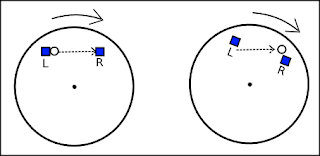
It took me a long time to understand why, if your throw an object in the direction of rotation, it should appear to move away from you or towards you. I only really got it whilst drawing the following diagram. Those blue squares represent a pair of hands, the small round thing is a ball, which starts from the left hand and is aimed at the right one. During the flight the hands rotate around the point in the middle, and if you're in control of the hands then the ball appears to make a curve. Of course somebody hovering above you would argue that your hands were curving and not the ball.